Guide No. 10 · The K-12 Series
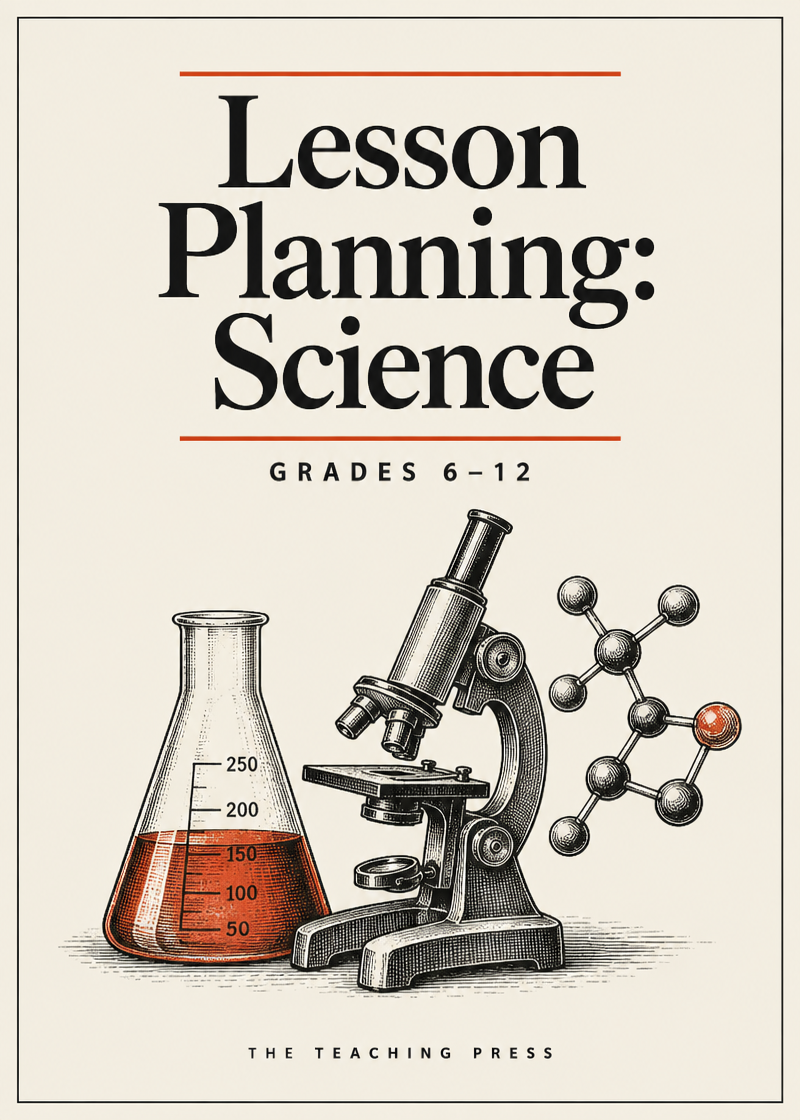
Lesson Planning: Science, Grades 6–12
Practicals with purpose — plan science lessons where the theory and the bench agree.
Secondary science is the only subject where the lesson can be dangerous, the equipment can be missing, and the exam tests a practical the students may never have done. Planning is where all three problems are solved — before the lesson, not during it.
This guide plans the theory–practical loop properly: practicals chosen to prove the theory, write-ups that build exam answers, and contingency plans for the day the gas taps don't work.
What's inside
- 01
The Theory–Practical Loop
Sequencing so the bench work proves the lesson, not interrupts it.
- 02
Required Practicals, Planned to the Minute
Setup, rotation, results, and write-up — with realistic timings.
- 03
Planning the Write-Up
Hypotheses, tables, and conclusions that become exam answers.
- 04
Data & Graph Questions
Building the examined skills: lines of best fit, anomalies, and evaluation.
- 05
Maths Inside Science
Rearranging equations, units, and standard form without a maths teacher present.
- 06
Safety, Logistics & Plan B
Risk assessments, technician requests, and the no-equipment fallback lesson.
Read an excerpt
Chapter 1 — The Theory–Practical Loop
The weakest science lessons run theory and practical in parallel universes: Monday's notes about osmosis, Thursday's practical about osmosis, and never the two shall meet. Plan them as one loop — prediction from theory, test at the bench, explanation back to theory.
If a practical doesn't prove, disprove, or complicate something the students just learned, it is entertainment. Entertainment has its place in education, but not in a double period on Thursday.
More in the series
No. 01
The Lesson Planning Field Guide
$12
No. 02
The Calm Classroom Handbook
$14
No. 03
The Worksheet Design Manual
$9
No. 04
The Strategy Playbook
$12
No. 05
Lesson Planning: English, Grades 1–5
$8
No. 06
Lesson Planning: Maths, Grades 1–5
$8
No. 07
Lesson Planning: Science, Grades 1–5
$7
No. 08
Lesson Planning: English, Grades 6–12
$9
No. 09
Lesson Planning: Maths, Grades 6–12
$10
No. 11
Preparing for a Lesson Observation
$12
No. 12
Answering Inspection Questions
$15
No. 13
Prepping Lessons After School Vacations
$5
No. 14
Handling Teacher Burnout: UAE Edition
$10
No. 15
How to Handle Subject Coordinators
$6
No. 16
How to Thrive in a Subject Department
$6
No. 17
Managing School Expectations
$7